

Quick answer
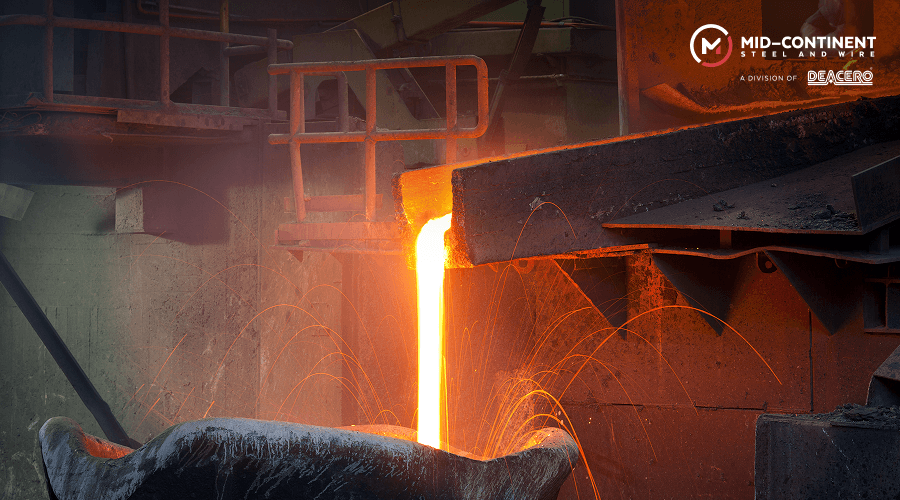
Steel is classified into four primary types: carbon steel, alloy steel, stainless steel, and tool steel. Each family is defined by its chemical composition — particularly its carbon content and the presence of alloying elements such as chromium, nickel, molybdenum, manganese, and vanadium — and each is engineered for distinct mechanical performance, corrosion resistance, and processing behavior. The American Iron and Steel Institute (AISI) and the Society of Automotive Engineers (SAE) catalog more than 3,500 individual grades across these four families (SAE International; AZoM), each tuned for a specific service environment.
This guide walks engineers, fabricators, and procurement professionals through each steel type, the grading systems that govern them, and a structured framework for selecting the right steel for any industrial project.
What is steel?
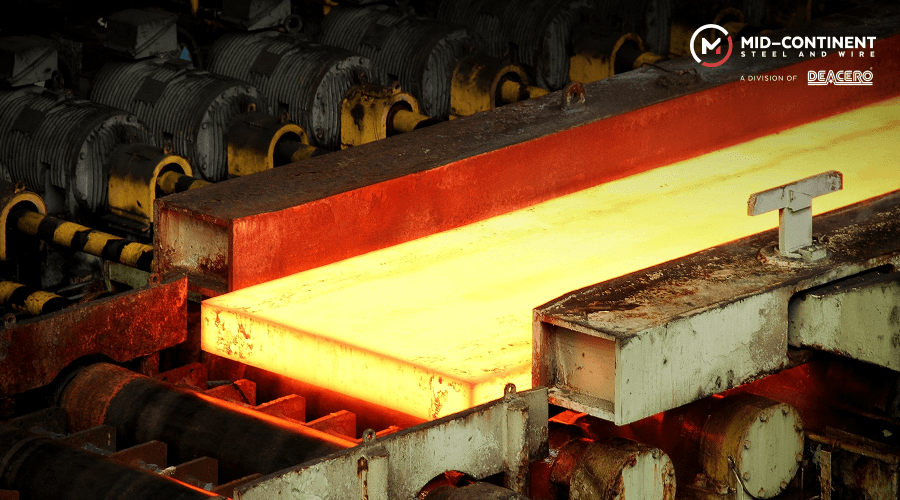
Steel is an iron-carbon alloy containing up to roughly 2% carbon by weight, plus controlled additions of other elements. The carbon content alone has an outsized effect on hardness, strength, ductility, and weldability — which is why steels are grouped first by carbon level and only secondarily by alloying chemistry.
Two facts that frame why steel selection matters at the industrial scale:
- Steel is the most recycled material on earth. Around 680 million tonnes of steel scrap were recycled in 2021, avoiding more than one billion tonnes of CO₂ emissions (World Steel Association).
- Producing one tonne of steel today requires just 40% of the energy it did in 1960, while global output has grown nearly tenfold over the same period (World Steel Association).
These two trends, recyclability and energy efficiency, are why steel remains the dominant structural and industrial material despite competition from aluminum, polymers, and composites. At Mid-Continent Steel & Wire, we lean heavily into this circular economy—manufacturing steel profiles from highly recycled content that generates significantly lower CO₂ emissions than the global traditional blast-furnace average.
How steel is classified and graded
Before exploring each type in detail, it helps to understand the two main grading systems used in North America.
The AISI/SAE four-digit system
The AISI/SAE system uses a four-digit code to identify the chemical composition of carbon and low-alloy steels (AZoM):
- First digit — the main alloying element family (1 = carbon, 2 = nickel, 3 = nickel-chromium, 4 = molybdenum, 5 = chromium, 6 = chromium-vanadium, 7 = tungsten, 8 = nickel-chromium-molybdenum, 9 = silicon-manganese).
- Second digit — modifier indicating significant secondary alloying elements.
- Last two digits — carbon content in hundredths of a percent (basis points). For example, 1060 steel is a plain-carbon steel with 0.60% carbon by weight (SAE steel grades).
Stainless steels use a three-digit system beginning with 2, 3, 4, or 5 (e.g., 304, 316, 410, 430), each digit family representing a metallurgical structure rather than a strict composition recipe.
The ASTM system
The ASTM International system identifies steel by application rather than chemistry. Codes such as ASTM A36 (general structural carbon steel) and ASTM A572 Grade 50 (high-strength low-alloy structural steel) specify the minimum mechanical properties, manufacturing process, and intended use (ANSI Blog).
In practice, both systems are used together. A purchase order for structural shapes might call for ASTM A572 Grade 50 to AISI 1020 chemistry equivalence — combining application requirements with composition control.
The four main types of steel
1. Carbon steel
Carbon steel is the largest category by volume, accounting for the majority of global steel production. It contains iron, carbon (typically up to 2.0%), and small amounts of manganese, silicon, and trace elements. Its mechanical behavior is driven almost entirely by carbon content.
The AISI subdivides carbon steel into three grades (King Steel; SAE):
Low-carbon steel (mild steel) — 0.05% to 0.30% carbon
- Properties: highly ductile, easy to weld, machine, and form; low tensile strength but excellent formability.
- Common grades: AISI 1010, 1018, 1020; ASTM A36 (the workhorse structural grade).
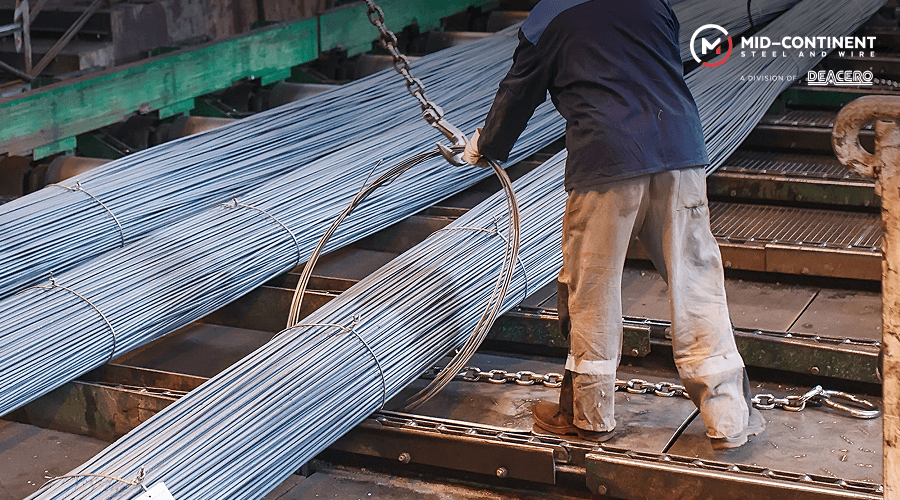
- Applications: structural shapes (I-beams, angle iron, channels), automotive body panels, sheet metal stampings, wire rod, fasteners, pipe, and rebar.
- Why it’s chosen: the most economical steel available with adequate strength for the vast majority of non-critical applications.
Medium-carbon steel — 0.30% to 0.60% carbon
- Properties: higher strength and hardness than low-carbon, with reduced ductility; responds well to heat treatment.
- Common grades: AISI 1040, 1045, 1050.
- Applications: axles, crankshafts, gears, railway components, machinery shafts, and structural elements requiring fatigue resistance.
High-carbon steel — 0.60% to 1.0% carbon (with ultra-high-carbon extending to ~2.0%)
- Properties: very high hardness and wear resistance after heat treatment; difficult to weld and form; brittle.
- Common grades: AISI 1080, 1095.
- Applications: springs, cutting tools, music wire, high-strength wire rope, and edged tools.
Ultra-high-carbon steels (1.25–2.0% carbon, e.g., D2 at 1.5%) reach the upper limit before powder metallurgy becomes necessary and are used for knives, punches, and specialty wear parts (Wikipedia).
A note on free-machining grades: the 11xx (resulfurized) and 12xx (resulfurized and rephosphorized) carbon-steel series add sulfur and phosphorus to improve machinability at the cost of weldability and ductility. Use these for screw-machine parts and CNC turning — not for welded assemblies (AZoM).
2. Alloy steel
Alloy steels contain carbon plus intentional additions of one or more alloying elements — typically chromium, nickel, molybdenum, manganese, silicon, vanadium, tungsten, cobalt, and boron — totaling more than the trace amounts found in plain-carbon steel. These additions dramatically expand the property envelope, giving designers the ability to optimize for strength, toughness, hardenability, corrosion resistance, or high-temperature performance.
Key alloying elements and their effects:
- Chromium (Cr) — corrosion resistance, hardness, wear resistance.
- Nickel (Ni) — toughness, ductility at low temperatures, corrosion resistance.
- Molybdenum (Mo) — high-temperature strength, hardenability, resistance to creep.
- Manganese (Mn) — hardenability, tensile strength, deoxidation.
- Vanadium (V) — grain refinement, fatigue resistance, hot hardness.
- Tungsten (W) — hot hardness and red-hardness in high-speed cutting tools.
- Silicon (Si) — strength and elasticity (e.g., spring steels).
Workhorse alloy grades:
- AISI 4140 — chromium-molybdenum (chromoly) steel with ~0.40% carbon. Heat-treatable to high strength while retaining good toughness. Used in oilfield drilling tools, axles, gears, high-strength fasteners, and forging dies (AZoM 4140 datasheet).
- AISI 4340 — adds nickel to 4140’s chrome-moly base for superior toughness at high strength. Used in heavily loaded shafts, aircraft landing gear, and structural components for armored vehicles (Bergsen Metal).
- AISI 8620 — nickel-chromium-molybdenum case-hardening grade. Used in gears, pinions, and bearings where a hard surface and tough core are needed.
- AISI 6150 — chromium-vanadium spring steel. Used in valve springs, torsion bars, and high-fatigue components.
HSLA (High-Strength Low-Alloy) steel deserves its own mention. HSLA steels — covered under ASTM A572, A588, A656, and similar specifications — use micro-additions of vanadium, columbium (niobium), and titanium to achieve yield strengths of 42,000 to 65,000 psi while remaining weldable and economical. ASTM A572 Grade 50 (50,000 psi minimum yield, 65,000 psi minimum tensile) is the most common, used widely in structural shapes, plates, sheet piling, and bars for bridges, buildings, and transmission towers (ANSI Blog; Kloeckner Metals).
3. Stainless steel
Stainless steel is defined by a minimum chromium content of 10.5%, which forms a passive chromium-oxide layer on the surface that self-heals when scratched — the source of its “stainless” corrosion resistance. Stainless grades are subdivided by their metallurgical structure (microstructure) rather than carbon content alone.
The five stainless families:
Austenitic stainless (300 series and 200 series)
- Structure: face-centered cubic (FCC), non-magnetic.
- Composition: typically 16–26% chromium and 6–22% nickel; 200-series substitutes manganese and nitrogen for some of the nickel (Wikipedia).
- Properties: excellent corrosion resistance, outstanding formability and weldability, high ductility, not heat-treatable to higher strength.
- Common grades: 304/304L (the most widely used stainless grade — food processing, kitchen equipment, architectural trim) and 316/316L (adds 2–3% molybdenum for chloride and marine resistance; used in marine fasteners, pharmaceutical equipment, and chemical processing) (SFS USA).
- Share of stainless market: roughly two-thirds of all stainless steel produced globally.
Ferritic stainless (400 series, low-carbon)
- Structure: body-centered cubic (BCC), magnetic.
- Composition: 10.5–27% chromium, low nickel.
- Properties: good corrosion resistance, moderate strength, good formability, not heat-treatable; less expensive than austenitic because of low nickel content.
- Common grades: 430 (automotive trim, appliance panels, kitchen utensils), 409 (automotive exhaust systems).
Martensitic stainless (400 series, higher carbon)
- Structure: body-centered tetragonal, magnetic, heat-treatable to high hardness.
- Composition: 11.5–18% chromium with higher carbon (0.15–1.2%).
- Properties: high strength and hardness after quench-and-temper; moderate corrosion resistance; less ductile than austenitic or ferritic.
- Common grades: 410 (valves, pump shafts, fasteners), 420 (cutlery, surgical tools), 440C (bearings, knife blades).
Duplex stainless
- Structure: roughly 50% ferrite / 50% austenite.
- Composition: 19–28% chromium, 4.5–8% nickel, 0.05–5% molybdenum.
- Properties: roughly twice the yield strength of standard austenitic grades, with superior chloride stress-corrosion cracking resistance. Used in offshore oil and gas, chemical processing, and desalination plants.
- Common grades: 2205, 2507 (super duplex).
Precipitation-hardening (PH) stainless
- Composition: 15–17% chromium, 3–5% nickel, plus copper, aluminum, or titanium (Ambica Steels).
- Properties: combines high strength (up to 41 HRC) with good corrosion resistance through controlled precipitation heat treatment.
- Common grades: 17-4 PH, 15-5 PH. Used in aerospace, nuclear, and high-performance shafts.
4. Tool steel
Tool steels are high-carbon, heavily alloyed steels engineered for hardness, abrasion resistance, and dimensional stability, the metallurgical requirements for making tools that cut, form, or shape other materials. The AISI/SAE system classifies tool steels into six groups by primary service condition (Wikipedia; AZoM):
| Group | AISI letter | Defining property | Typical grades | Applications |
| Water-hardening | W | Lowest cost; quenched in water | W1, W2 | Hand tools, cold chisels, blacksmith tools |
| Cold-work, oil-hardening | O | Oil-quenched; minimal distortion | O1 | Drill bushings, gauges, blanking dies |
| Cold-work, air-hardening | A | Medium alloy; air-quenched | A2 | Punches, forming dies, shear blades |
| Cold-work, high-carbon high-chromium | D | High wear resistance | D2, D3 | Long-run stamping dies, slitter knives |
| Shock-resisting | S | High impact toughness | S1, S5, S7 | Pneumatic chisels, punches, blacksmith dies |
| Hot-work | H | Strength at elevated temperatures | H11, H13 | Die-casting dies, forging dies, extrusion tools |
| High-speed, tungsten | T | Tungsten-base; red-hardness | T1, T15 | Cutting tools, milling cutters, drills |
| High-speed, molybdenum | M | Molybdenum-base; cheaper than T | M2, M42 | Twist drills, taps, lathe tools |
| Plastic mold | P | Tailored for injection molds | P20 | Zinc die-casting dies, plastic molds |
| Special purpose | L | Low-alloy specialty | L6 | Bandsaw blades, tough cutting components |
The hot-work H-series and high-speed M- and T-series are the metallurgically demanding end of the spectrum: H1–H19 are chromium-based (5% Cr), H20–H39 are tungsten-based (9–18% W with 3–4% Cr), and H40–H59 are molybdenum-based (Wikipedia).
A note on the four main types and beyond
While the four-category framework above is universally cited and accurate, it is worth flagging that some classifications, including those used by metallurgical bodies, treat HSLA, maraging, and weathering steels as distinct families. For practical purchasing and design, however, they fall under the alloy-steel umbrella and are most easily understood as engineered variants of the alloy-steel family.
Mechanical properties at a glance
The table below compares typical mechanical-property ranges for representative grades in each family. Use it as a rough comparison, always confirm exact properties against the relevant ASTM or AISI specification and supplier mill test report.
| Steel family | Representative grade | Yield strength (psi) | Tensile strength (psi) | Hardness | Elongation | Weldability |
| Low-carbon | ASTM A36 / AISI 1018 | 36,000–54,000 | 58,000–80,000 | 67–71 HRB | 20–25% | Excellent |
| Medium-carbon | AISI 1045 | 45,000–77,000 | 82,000–91,000 | 84 HRB (annealed) | 16% | Fair |
| High-carbon | AISI 1095 | 72,000 | 100,000+ | 55–58 HRC (hardened) | 10% | Poor |
| HSLA | ASTM A572 Grade 50 | 50,000 | 65,000 | — | 18% | Very good |
| Alloy | AISI 4140 (Q&T) | 95,000–135,000 | 110,000–180,000 | 28–32 HRC | 15–20% | Good (preheat) |
| Alloy | AISI 4340 (Q&T) | 125,000–217,000 | 145,000–270,000 | 35–45 HRC | 12–18% | Good (preheat) |
| Austenitic stainless | 304 | 30,000 | 75,000 | 70 HRB | 40% | Excellent |
| Austenitic stainless | 316 | 30,000 | 75,000 | 79 HRB | 40% | Excellent |
| Martensitic stainless | 410 | 40,000 | 70,000 | 80 HRB (annealed) | 22% | Fair |
| Tool steel | D2 (heat-treated) | — | — | 58–62 HRC | <5% | Difficult |
| Tool steel | H13 (heat-treated) | — | — | 44–54 HRC | 12% | Fair (preheat) |
Sources: Service Steel, AZoM 4140, Ambica Steels, ANSI Blog.
Heat treatment: how steel properties are tuned
The same chemistry can yield dramatically different mechanical behavior depending on how it is heat-treated. Four core processes dominate industrial practice (Investment Casting PCI):
- Annealing — heat to above the critical temperature, hold, then slow-cool. Reduces hardness, relieves internal stress, improves machinability and ductility.
- Normalizing — heat above critical, hold, then air-cool. Refines grain structure, improves toughness, often used as a pre-treatment before quenching.
- Quenching — heat above critical, then rapidly cool in water, oil, or polymer. Produces a hard martensitic structure but introduces brittleness and residual stress.
- Tempering — reheat the quenched part below the critical temperature, hold, and cool. Reduces brittleness, balances hardness with toughness, and is almost always paired with quenching.
The combination of quenching plus tempering, often called Q&T, is the dominant route for producing high-strength alloy steels (4140, 4340, 8620) and martensitic stainless grades (410, 420, 440C).
Industrial applications by type
The pairings below summarize how each steel family is typically deployed in industrial practice.
Construction and infrastructure
- Low-carbon and HSLA steels (A36, A572, A992) — structural beams, columns, plates, rebar, decking, lintels, angle iron, sheet piling.
- Weathering steel (A588, A606) — exposed bridges, architectural facades, signage structures.
Automotive and transportation
- Low-carbon sheet — body panels, frames, brackets.
- Medium-carbon and alloy steels — crankshafts, connecting rods, axles, gears (4140, 4340, 8620).
- Advanced high-strength steel (AHSS) — crash-safety components in modern vehicle architectures.
- Stainless 409 and 304 — exhaust systems, trim.
Oil, gas, and energy
- Alloy steel (4130, 4140, 4145) — drill collars, drill pipe, downhole tools.
- Duplex and super-duplex stainless (2205, 2507) — offshore risers, subsea manifolds, desalination equipment.
- Heat-resistant alloy steels — boiler tubes, pressure vessels, turbine casings.
Manufacturing and tooling
- D2, A2, O1 tool steel — stamping dies, blanking dies, forming punches.
- H13 hot-work tool steel — die-casting dies, forging dies, extrusion mandrels.
- M2 and M42 high-speed steel — cutting tools, drills, milling cutters, hobs.
Consumer and architectural
- 304 stainless — kitchen equipment, food processing, architectural trim, fasteners.
- 316 stainless — marine hardware, pharmaceutical and chemical equipment.
- 430 stainless — appliance panels, automotive trim, decorative applications.
Industrial machinery
- AISI 1045, 4140 — shafts, axles, spindles.
- AISI 8620 — case-hardened gears, pinions, bushings.
- Spring steels (1060, 1095, 6150) — valve springs, leaf springs, torsion bars.
How to choose the right steel for your project
Selecting a steel grade is rarely about chemistry alone. The decision flow below mirrors how MCSW’s technical team works through specifications with customers.
Step 1 — Define the service environment
- Indoor, dry, non-corrosive? Plain carbon steel (A36, 1018) is almost always the most economical answer.
- Outdoor, exposed to moisture? Galvanized carbon steel or weathering steel (A588). Coastal or chloride exposure pushes you to 316 stainless or duplex grades.
- Elevated temperature? Alloy steels with molybdenum (4140) for moderate heat; H-series tool steels or stainless 309/310 for sustained high temperatures. For extreme environments, components must be specified with pressure vessel quality ratings to ensure long-term structural integrity under pressure.
- Cryogenic? Austenitic stainless (304L, 316L) retains ductility down to liquid-nitrogen temperatures.
Step 2 — Quantify the mechanical demand
- Identify the maximum service load and load type (static, dynamic, fatigue, impact).
- Determine required yield strength, tensile strength, and minimum elongation.
- For fatigue-critical or shock-loaded applications, prioritize toughness over peak hardness — alloy steels in the Q&T condition usually outperform high-carbon steels.
Step 3 — Account for fabrication
- Welded assemblies: stick to low-carbon (A36, 1018) or low-alloy weldable grades (A572). Carbon equivalents above ~0.45% require preheat and post-weld heat treatment.
- High-volume machining: consider free-machining grades (1144, 12L14) or improved-machinability stainless (303).
- Forming and stamping: low-carbon sheet (1008–1010) and austenitic stainless (304) are the standards.
- Heat treatment to high hardness: medium- and high-carbon steels, alloy steels (4140, 4340), and tool steels.
Step 4 — Optimize for cost
- Plain carbon steel is the baseline; everything above costs more by a factor of 1.5× (HSLA) to 8–15× (high-end tool steel and super-duplex stainless).
- Where possible, use the lowest-cost steel that meets the mechanical and environmental requirements — overspecifying inflates project cost without adding service value.
- Consider total lifecycle cost: a 316 stainless component in a chloride environment will outlast and outperform a painted carbon steel equivalent that requires periodic recoating or replacement.
Step 5 — Verify with documentation
- Require mill test reports (MTRs) confirming heat number, chemistry, and mechanical properties to the specified ASTM or AISI standard.
- For critical applications, specify supplementary requirements: Charpy impact testing, ultrasonic inspection, or third-party witness testing.
Frequently asked questions
What are the 4 types of steel?
The four primary types of steel are carbon steel, alloy steel, stainless steel, and tool steel, classified by chemical composition and intended use. Each is further divided into grades — over 3,500 in total — engineered for specific mechanical, thermal, and corrosion performance.
Which type of steel is most widely used?
Low-carbon (mild) steel — particularly grades like ASTM A36 and AISI 1018 — is the most widely used type of steel by volume. It dominates structural construction, automotive sheet, pipe, and general fabrication because of its low cost, excellent weldability, and adequate strength for the vast majority of applications.
What is the difference between MS and SS?
MS (mild steel) is low-carbon steel with up to 0.30% carbon and minimal alloying — economical, weldable, and prone to corrosion. SS (stainless steel) contains at least 10.5% chromium, which forms a corrosion-resistant passive oxide layer. Stainless costs significantly more but offers superior corrosion resistance, hygiene, and appearance.
What are the most useful steel grades?
The “most useful” depends on application, but the following grades cover the majority of industrial demand:
- Structural: ASTM A36, A572 Grade 50, A992.
- Automotive and machinery: AISI 1018, 1045, 4140, 4340, 8620.
- Stainless: 304/304L, 316/316L, 410, 430.
- Tool steel: D2, A2, O1, H13, M2.
Will we ever run out of steel?
Realistically, no. Steel is the most recycled material on earth, around 680 million tonnes were recycled in 2021 alone (World Steel Association). Iron ore reserves remain abundant, and the circular nature of the scrap-steel market means existing steel is repeatedly remelted into new products. Energy use per tonne has dropped roughly 60% since 1960, and the industry continues to invest in green-steel technology, direct-reduced-iron and hydrogen-based steelmaking, to further reduce emissions.
How is steel graded?
Two systems dominate in North America: the AISI/SAE four-digit system for chemistry (e.g., 1018, 4140, 8620) and the ASTM system for application (e.g., A36, A572, A992). Stainless steels use the three-digit AISI series (200, 300, 400, 500) based on metallurgical structure. International equivalents include the European EN system and the Japanese JIS system.
Why are there so many steel grades?
Steel is fundamentally a tunable material. Small adjustments in carbon content, alloying chemistry, and heat treatment produce significantly different mechanical behavior, allowing the same base alloy system to serve markets as different as automotive body panels, surgical implants, oilfield drill pipe, and aircraft landing gear. The 3,500+ grades reflect a century of metallurgical refinement targeted at specific service environments (Mead Metals).
Conclusion: choosing the right steel for your project
Steel selection is a structured engineering decision, not a default. The right grade is the one that meets the mechanical load, survives the service environment, fabricates economically, and arrives with the documentation needed for traceability. A practical framework:
- For general structural and fabrication work, start with carbon steel — A36 for shapes and plate, 1018 for bar stock.
- For high-strength structural applications, step up to HSLA grades such as ASTM A572 Grade 50.
- For machine components, shafts, and gears, alloy steels (4140, 4340, 8620) deliver the balance of strength and toughness.
- For corrosive, marine, or hygienic environments, stainless steel — 304 for general use, 316 for chlorides, duplex for severe service.
- For cutting, forming, and shaping tools, tool steels matched to the service condition (D2 cold-work, H13 hot-work, M2 high-speed).
At Mid-Continent Steel and Wire, our metallurgical and technical team works with industrial customers across the United States to specify, source, and supply the right steel for each project — from structural shapes and rebar to high-strength sections and engineered alloy products. With 35+ years of supply experience and full mill traceability on every order, we help engineers turn material specifications into delivered, project-ready inventory.
Sources and further reading
- AZoM. SAE/AISI Carbon Steel Naming Conventions.
- AZoM. Tool Steel Classifications and AISI 4140 Alloy Steel (UNS G41400).
- ANSI Blog. Standard for High-Strength Low-Alloy (HSLA) Structural Steel (ASTM A572/A572M-21).
- King Steel Corp. Carbon Steel Basics.
- Kloeckner Metals. A572 Steel Explained: Grades, Applications, and Benefits.
- Service Steel. What is A36 Steel? Composition, Properties, and Uses.
- Bergsen Metal. 4140 vs. 4340 Steel Alloy.
- SFS USA. 300 Series Stainless Steel vs 400 — 304 vs 410.
- Ambica Steels. What is Stainless Steel — Austenitic, Ferritic, Martensitic, Duplex, PH.
- Wikipedia. Carbon Steel, Austenitic Stainless Steel, Tool Steel, SAE Steel Grades.
- Investment Casting PCI. Normalizing vs. Tempering vs. Annealing vs. Quenching.
- World Steel Association. Circular Economy and Sustainability Indicators Report 2025.