
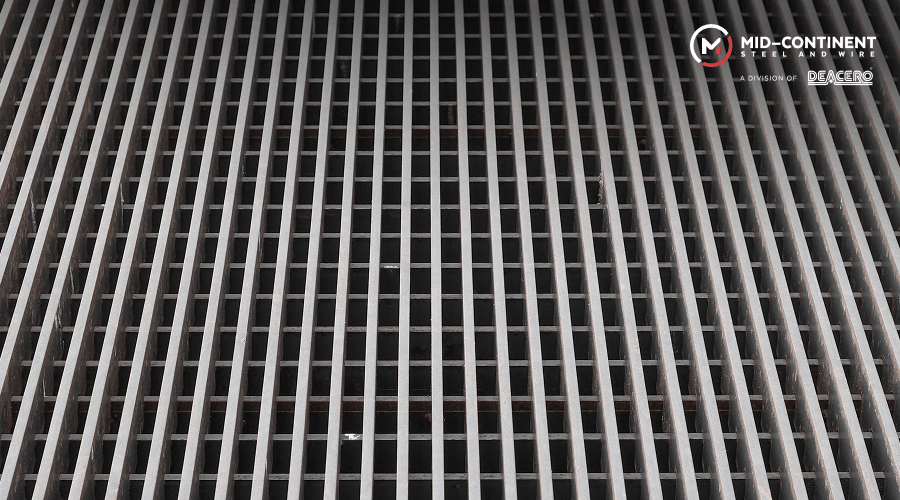

The performance of steel grating starts with the quality and properties of the bar stock used to fabricate it. At Mid-Continent Steel & Wire (MCSW), we approach grating from the material up: supplying the flat bars, rounds, squares, angles, and channels that serve as the raw-material foundation for welded and galvanized steel bar grating.
Whether you need a single production run or a custom fabrication program, understanding the materials and specifications behind a grating panel is critical. Bearing bar dimensions, cross-bar configuration, steel grade, fabrication method, and finish all influence the final product’s performance and suitability for its intended application. Let’s dive into what steel grating is, how it gets fabricated, the steel grades involved, and the source bar products available to build it!
What is steel grating?
Steel grating — also called steel bar grating or metal bar grating — is an open-grid assembly of metal bars where the principal load-bearing bars run parallel in one direction, spaced equidistant from one another, and are joined to cross bars running perpendicular to them (NAAMM Metal Bar Grating Manual MBG 531). The result is a rigid, load-bearing surface with open spacing that allows light, air, water, and debris to pass through.
That open-grid design is exactly why welded bar grating gets specified across so many industrial environments: it provides traction and load capacity while letting water drain and air ventilate freely (Floor Safety Store, LinkedIn). It’s the workhorse industrial flooring applications rely on for platforms, catwalks, mezzanines, stair treads, trench covers, and security screens. Because of its open-grid design, steel grating allows water and debris to pass through rather than collecting on a solid surface, which can simplify drainage and maintenance.
Every grating panel gets defined by two key components:
- Bearing bars — the vertical, load-carrying bars that run in the direction of the span. These typically range from 3/4″ x 1/8″ for light pedestrian traffic up to 7″ x 1/2″ for extreme vehicular loads (Marco Specialty Steel). Bearing bar size, spacing, span, and support conditions all influence the load-carrying capacity and suitability of a grating panel. Narrower spacing may also be specified where ADA-compliant openings are required for accessible pedestrian areas.
- Cross bars — the bars set perpendicular to the bearing bars that lock them into position and provide lateral stability. Cross-bar profile and spacing vary with the assembly method (Marco Specialty Steel).
What are the two main types of grating?
The two most common fabrication methods in North American steel grating are welded and pressure-locked grating. NAAMM also recognizes riveted grating as a third construction type. (NAAMM MBG 532).
1. Welded steel grating (Electro-forged)
The most common and most economical type for industrial use! Bare steel bearing bars and cross bars get fused at every intersection using resistance (electro-forge) welding — heat plus hydraulic pressure causes the cross bar to penetrate and permanently bond to the bearing bar (Miner Grating load tables). Welded grating offers a strong combination of load-carrying capacity, durability, and cost efficiency, (Goldsupplier Steel Grating Guide) making it a common choice for industrial platforms, walkways, stair treads, and heavy-duty flooring.
2. Pressure-locked grating (Press-locked & Swage-locked)
Cross bars get mechanically locked into notched bearing bars under intense hydraulic pressure — no welding involved (NAAMM MBG 531 draft). This produces a clean, uniform surface without visible weld points, making pressure-locked grating suitable for architectural applications, pedestrian areas, and installations where a consistent appearance is desired. (Goldsupplier). Swage-locked grating, a related pressure-locked method common in aluminum, swages tube cross bars into pre-punched holes (Grating Pacific).
A third type—riveted grating—uses riveted construction and is often selected for demanding applications such as bridge decking, mining, and heavy vehicular traffic. (Floor Gratings power pages).
| Type | Typical Load Performance | Typical Cost Position | Best For |
| Welded | Highest | Lowest | Industrial platforms, walkways, stair treads, heavy traffic (Goldsupplier) |
| Pressure-locked | Medium | Medium | Architectural facades, pedestrian areas, stainless installations (Goldsupplier) |
| Riveted | Highest (impact) | Higher | Heavy bridge decking, mining, rolling vehicular loads (Floor Gratings) |
The source bar materials for grating fabrication
This is where grating quality gets won or lost! Every grating panel begins with bar stock, and the grade, dimensions, and properties of that material influence the finished product’s load capacity, weldability, durability, and overall performance. MCSW supplies the full range of bar products used in grating fabrication.
Flat bars — The bearing-bar backbone
Flat bars are a critical grating input because they typically serve as the primary load-bearing members of the finished panel. They become the vertical bearing bars that carry the load! Our MCSW flat bars are described for “open core crossbars, structure reinforcements” and similar structural duty (MCSW Bars) — precisely the rectangular cross-section needed for bearing bars. In grating, these bars typically range from 3/4″ x 1/8″ up to 7″ x 1/2″ depending on the duty rating (Marco Specialty Steel). The most popular industrial bearing bar is 1″ or 1-1/2″ deep at 3/16″ thick (KangKai bar grating sizes).
Rounds & squares — Cross bars and connecting bars
Round bars serve as cross bars / cross rods in many welded gratings, while twisted square bars are the most common cross-bar form in a large share of welded grating (CSSP Grating)! Our MCSW rounds are available up to 2-1/2″ diameter and squares in standard 20–60 ft lengths (MCSW Bars), supporting the round-rod and twisted-square cross-bar profiles grating fabricators rely on. Industry guide specifications call for round steel cross rods to ASTM A510 (LANL guide spec).
Angles & channels — Frames, banding, and supports
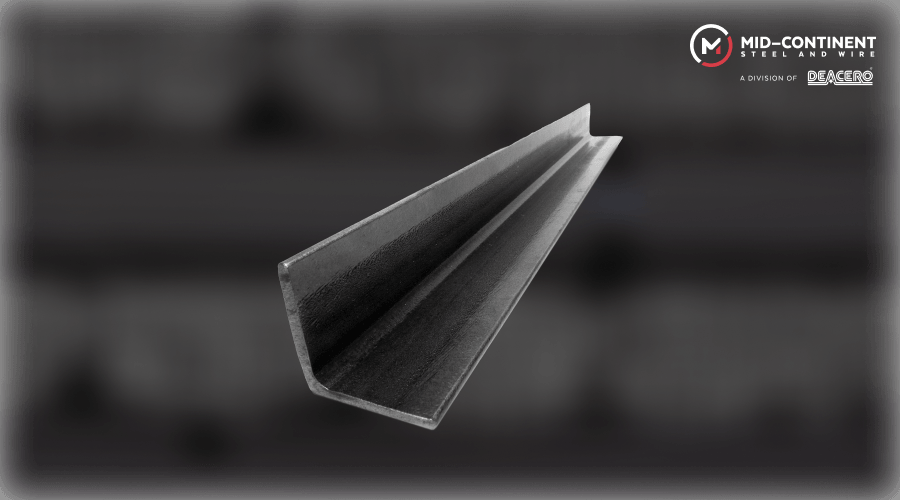
Grating panels need perimeter frames, banding bars, and structural supports. Our MCSW angles (“braces for structural components like bridges or buildings, framing, brackets”) and channels (“buildings, framing, brackets”) provide the carrier framing and perimeter angle frames that grating systems get installed into (MCSW Bars). Guide specifications routinely call for perimeter angle frames and support framing fabricated from the same basic steel as the grating itself (LANL guide spec).
Steel grades available
MCSW supplies bar products in a range of recognized structural steel grades, depending on the product, size, and application. Charpy impact testing is also available upon request for MCSW Bars. These grades include: (MCSW Bars)
- ASTM A36 — carbon structural steel, the baseline grade for steel bar grating and the most widely specified material for welded carbon grating (Ametco guide spec; Ohio Gratings PW30 spec)
- ASTM A529-50 / A529-55 — high-strength carbon-manganese structural steel
- ASTM A572-50 — high-strength low-alloy structural steel
- ASTM A992 — structural steel for added strength applications
ASTM A36 is the grade explicitly named in NAAMM-compliant grating guide specifications for bearing bars, angles, and shapes (Ametco)! Standard MCSW lengths run 20 ft to 60 ft, with shorter cut lengths available — giving fabricators flexibility for both production-run and custom sizes for grating programs (MCSW Bars).
What are standard steel grating sizes and configurations?
There’s no single “standard” — grating gets specified by a code that captures bearing-bar spacing, construction type, and cross-bar spacing! The most common industrial configuration is 19-W-4: bearing bars spaced 1-3/16″ on center, welded (“W”), with cross bars spaced 4″ on center (Grating Pacific spacings table). This is “the workhorse of industrial flooring,” used for platforms, catwalks, mezzanines, and stairways.
Common north american spacings (NAAMM)
- 19-W-4 — bearing bars 1-3/16″ O.C., cross bars 4″ O.C. (general industrial)
- 15-W-4 — bearing bars 15/16″ O.C., increasing load capacity ~26% over 19-spacing
- 11-W-4 / 7-W-4 — close-mesh, may be specified for accessible pedestrian areas when the resulting opening dimensions meet applicable ADA requirements.
- 22-W-4 / 30-W-4 / 38-W-4 — wider spacing / heavy-duty configurations (Grating Pacific; TH Grating size chart)
Standard panel sizes
Common stock panel dimensions may include 3 ft wide by 20 or 24 ft long, although available sizes vary by manufacturer, grating type, and project requirements (914 mm x 6,096 or 7,315 mm) (KangKai). In metric markets, panels are typically 1000 mm x 6000 mm or 1000 mm x 5800 mm (Steel Grating World). Panels then get cut and fabricated to fit specific frame sizes — which is where the source bar lengths matter.
Stair treads
Grating stair treads are a specialized cut-to-size product. Standard treads range 22″–48″ wide and 7″–12″ deep, with a 1″–1.25″ nosing overhang for slip resistance (Goldsupplier stair treads)! To facilitate bolting to the stringers, they are supplied with carrier plates featuring standard bolt holes. Stair tread design and load requirements should be evaluated against applicable OSHA regulations, building codes, and project-specific engineering requirements (Goldsupplier; OSHA 1910.25).
Galvanized steel grating: corrosion protection
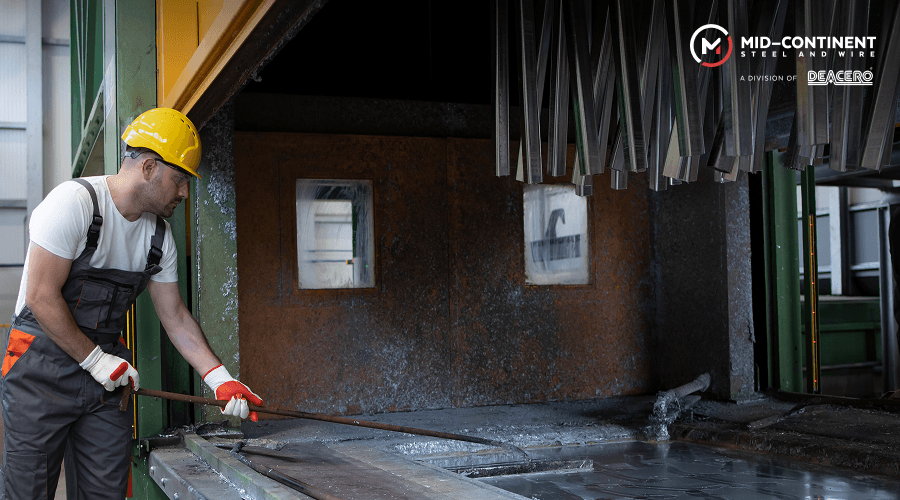
Carbon steel grating gets most often finished by hot-dip galvanizing, which applies a zinc coating per ASTM A123. The zinc coating provides sacrificial corrosion protection, helping protect the underlying steel from corrosion. (Goldsupplier stair treads) (Galvanized Mesh Products)
The standard finish stack for carbon steel grating:
- Mill / self-color — uncoated, for indoor or to-be-painted applications
- Painted / powder-coated — enhanced appearance and light corrosion resistance
- Hot-dip galvanized (ASTM A123) — provides long-term corrosion protection for outdoor and demanding environments; the finished weight increases due to the added zinc coating. (Goldsupplier stair treads)
For carbon steel grating, NAAMM-compliant guide specs reference ASTM A36 for bearing bars and shapes, ASTM A510 for round cross rods, and ASTM A123 for hot-dip galvanizing after fabrication (LANL guide spec; Ametco).
Surfaces: plain vs. serrated
- Plain (smooth) grating — the most common surface, used for general industrial flooring, stair treads, and trench covers (Steel Bar Grating).
- Serrated grating — bearing bars have a saw-tooth top edge for superior slip resistance in wet, oily, or icy conditions! Serrated bearing bars provide additional slip resistance, particularly in wet or oily environments. Because serration changes the effective cross-section of the bearing bar, the appropriate bar depth and load rating should be selected according to the applicable grating design tables. (Floor Gratings). OSHA-compliant stair treads frequently specify serrated surfaces for industrial environments (ZT Steel Structure).
What is steel grating used for?
The open-grid design makes steel grating the default load-bearing flooring across heavy industry:
- Platforms, catwalks, and mezzanines — high strength-to-weight ratio with built-in drainage (Grating Pacific)
- Stair treads and walkways — slip-resistant surfaces that can be specified to meet applicable OSHA requirements and project-specific safety standards. (Goldsupplier)
- Trench, drainage, and sewer covers — galvanized carbon grating in municipal and industrial drainage (Galvanized Mesh Products)
- Ventilation and ventilated flooring — open area allows continuous airflow (Galvanized Mesh Products)
- Security screens and fencing — rigid, see-through barriers
- Bridge decking and vehicular surfaces — heavy-duty riveted and welded grating (Floor Gratings)
Manufacturing capability: why source the steel from the manufacturer
Sourcing grating materials from a supplier with integrated steel manufacturing capabilities can reduce supply-chain complexity and provide greater visibility into the source material. Mid-Continent Steel & Wire is an American manufacturer and a DEACERO company, with 35 years of steel industry experience and an integrated business model that supports one of the widest, most comprehensive product lines of industrial-grade steel (MCSW).
For grating programs, that means:
- Domestic, traceable bar stock in ASTM A36, A529-50, A529-55, A572-50, and A992, with Charpy testing on request (MCSW Bars)
- The full bar geometry set — flat bars for bearing bars, rounds and squares for cross bars, angles and channels for frames and banding — sourced from a single supplier! (MCSW Bars)
- Flexible lengths from 20–60 ft plus shorter cut lengths for production-run and custom fabrication (MCSW Bars)
- Markets served including Commercial Building and Manufacturing — the primary destinations for grating (MCSW Bars)
Source your grating steel from Mid-Continent Steel & Wire
Whether you’re fabricating welded or galvanized bar grating for a production run or a custom project, start with the bar stock that helps determine its performance. Explore the full range of bar products — flat bars, rounds, squares, angles, and channels — or contact our team to discuss the material specifications and supply requirements for your next grating program.
Frequently asked questions
What is a steel grating?
Steel grating is an open-grid assembly of parallel load-bearing bars joined to perpendicular cross bars, creating a rigid flooring surface with open spacing for drainage, ventilation, and traction (NAAMM MBG 531).
What are the two main types of grating?
The two most common are welded grating (bearing and cross bars fused by electro-forge welding) and pressure-locked grating (cross bars mechanically locked under hydraulic pressure). NAAMM also recognizes riveted grating as a third type (NAAMM MBG 532).
What size is a standard steel grating?
The most common configuration is 19-W-4 — bearing bars 1-3/16″ on center, welded, with cross bars 4″ on center. Standard panels are commonly 3 ft x 20–24 ft and then get cut to fit the frame (Grating Pacific; KangKai).
What is grating used for?
Industrial flooring, platforms, catwalks, mezzanines, stair treads, walkways, trench and drainage covers, ventilation flooring, security screens, and bridge decking (Grating Pacific; Galvanized Mesh Products).
Which steel grades are used to make grating?
Carbon structural steel — most commonly ASTM A36 — is the baseline for welded carbon grating, with round cross rods often to ASTM A510 and hot-dip galvanizing to ASTM A123. Higher-strength grades such as A529-50/55, A572-50, and A992 are available for added strength (Ametco; MCSW Bars).