
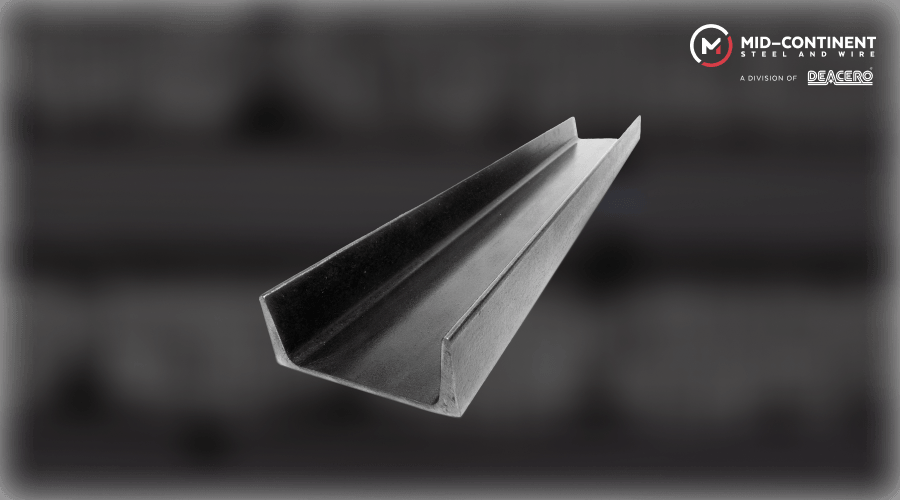

C channel steel is one of the most widely used structural shapes in construction, manufacturing, and equipment fabrication because it combines high strength, efficient load distribution, and easy fabrication in a versatile profile. Known as the American Standard Channel (C-shape) is a hot-rolled structural steel section with a “C”-shaped cross section, a vertical web, and two horizontal flanges that taper on their inner faces at roughly a 16.67% slope (2-in-12). It is designated by depth and weight per foot (for example, C8×11.5 is 8 inches deep and weighs 11.5 lb/ft), produced in depths from 3 to 15 inches, and most commonly rolled to ASTM A36. Engineers and fabricators specify it for framing, bracing, supports, and reinforcement because of its strong strength-to-weight ratio and the flat surface back of its web, which makes it incredibly easy to bolt or weld flush against another member.
If you are sizing, sourcing, or estimating a C channel for a project, this guide walks through the dimensions, weights, section properties, grades, and standards you need — followed by the questions buyers most often ask.
What is C channel steel?
C channel steel is a structural steel shape whose profile resembles the letter “C”: a single web with two flanges projecting from the same side. In U.S. practice, the American Institute of Steel Construction (AISC) recognizes two channel families:
- C-shapes (American Standard Channels) — tapered inner flange surfaces at the standard ~16.67% (2-on-12) slope.
- MC-shapes (Miscellaneous Channels) — channels whose proportions fall outside the standard C series, typically with wider or deeper flanges for the same depth.
The shapes are designated by the letter mark, the nominal depth in inches, and the nominal weight in pounds per foot. A C12×25, for instance, is a C-shape nominally 12 inches deep weighing 25 lb/ft.
Because one face of the web is flat (the back of the channel), C channel seats cleanly against plates, beams, and walls, which is why it shows up so often in framing, bracing, and support applications.
What is C channel steel made of?
Most structural C channels in North America are hot-rolled carbon steel produced to ASTM A36, a general-purpose mild steel structural grade. The A36 channel carries a minimum yield point of 36 ksi (250 MPa) and a tensile strength of 58–80 ksi (400–550 MPa), with a maximum carbon content around 0.26%.
ASTM A36 remains the most commonly specified grade for standard structural carbon steel channels, but channels and structural bars are also supplied in higher-strength low-alloy grades when a project calls for more yield strength at the same weight — A572-50 (50 ksi yield) being the most common alternative.
At Mid-Continent Steel & Wire, our structural bars and shapes are manufactured to ASTM A36, A529-50, A529-55, A992, and A572-50 specifications, giving fabricators and engineers access to consistent material quality across a wide range of structural applications.
C channel steel dimensions and weight chart
The table below lists the most widely stocked American Standard Channels (C-shapes) to ASTM A6/AISC, with overall depth, flange width, web thickness, and nominal weight per foot. All values are from the AISC Steel Construction Manual / ASTM A36 dimensional tables.
| Designation | Depth, d (in) | Flange width, b_f (in) | Web thickness, t_w (in) | Weight (lb/ft) |
| C3 × 4.1 | 3.00 | 1.410 | 0.170 | 4.1 |
| C3 × 5.0 | 3.00 | 1.498 | 0.258 | 5.0 |
| C3 × 6.0 | 3.00 | 1.596 | 0.356 | 6.0 |
| C4 × 5.4 | 4.00 | 1.584 | 0.184 | 5.4 |
| C4 × 7.25 | 4.00 | 1.721 | 0.321 | 7.25 |
| C5 × 6.7 | 5.00 | 1.750 | 0.190 | 6.7 |
| C5 × 9.0 | 5.00 | 1.885 | 0.325 | 9.0 |
| C6 × 8.2 | 6.00 | 1.920 | 0.200 | 8.2 |
| C6 × 10.5 | 6.00 | 2.034 | 0.314 | 10.5 |
| C6 × 13.0 | 6.00 | 2.157 | 0.437 | 13.0 |
| C7 × 9.8 | 7.00 | 2.090 | 0.210 | 9.8 |
| C7 × 12.25 | 7.00 | 2.194 | 0.314 | 12.25 |
| C7 × 14.75 | 7.00 | 2.299 | 0.419 | 14.75 |
| C8 × 11.5 | 8.00 | 2.260 | 0.220 | 11.5 |
| C8 × 13.75 | 8.00 | 2.343 | 0.303 | 13.75 |
| C8 × 18.75 | 8.00 | 2.527 | 0.487 | 18.75 |
| C9 × 13.4 | 9.00 | 2.433 | 0.233 | 13.4 |
| C9 × 15.0 | 9.00 | 2.485 | 0.285 | 15.0 |
| C9 × 20.0 | 9.00 | 2.648 | 0.448 | 20.0 |
| C10 × 15.3 | 10.00 | 2.600 | 0.240 | 15.3 |
| C10 × 20.0 | 10.00 | 2.739 | 0.379 | 20.0 |
| C10 × 25.0 | 10.00 | 2.886 | 0.526 | 25.0 |
| C10 × 30.0 | 10.00 | 3.033 | 0.673 | 30.0 |
| C12 × 20.7 | 12.00 | 2.942 | 0.282 | 20.7 |
| C12 × 25.0 | 12.00 | 3.047 | 0.387 | 25.0 |
| C12 × 30.0 | 12.00 | 3.170 | 0.510 | 30.0 |
| C15 × 33.9 | 15.00 | 3.400 | 0.400 | 33.9 |
| C15 × 40.0 | 15.00 | 3.520 | 0.520 | 40.0 |
| C15 × 50.0 | 15.00 | 3.716 | 0.716 | 50.0 |
How to read a designation: in C10 × 20, the 10 is the nominal depth in inches and the 20 is the weight in pounds per linear foot. Within a single depth group, a heavier weight means a thicker web and a slightly wider flange and specific inside radius corners.
C channel section properties
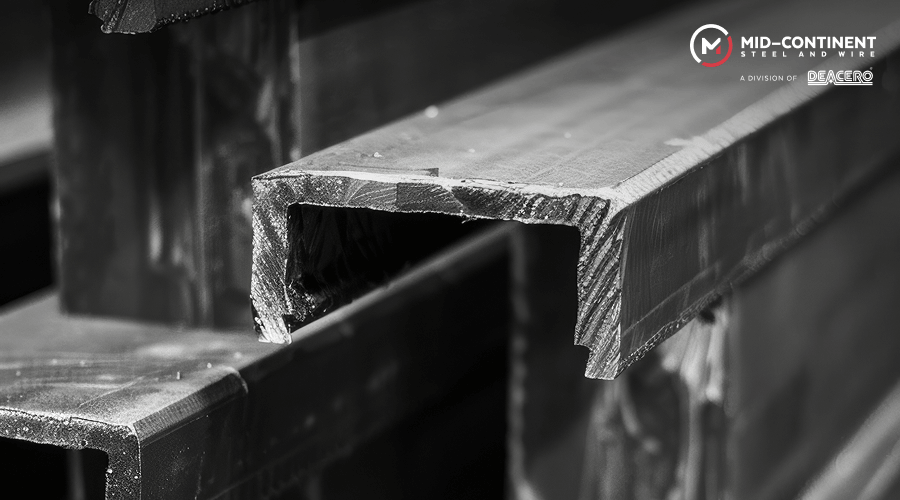
For load calculations, the geometry above matters less than the section properties — cross-sectional area, moment of inertia (I), and section modulus (S) about the strong (x) axis. These govern bending strength and deflection. The values below are standard AISC section properties for C-shapes. Material grade affects strength but not the geometric section properties shown here.
| Designation | Area (in²) | I_x (in⁴) | S_x (in³) | I_y (in⁴) | S_y (in³) |
| C5 × 6.7 | 1.97 | 7.49 | 3.00 | 0.48 | 0.38 |
| C6 × 8.2 | 2.40 | 13.1 | 4.38 | 0.69 | 0.49 |
| C6 × 13.0 | 3.83 | 17.4 | 5.80 | 1.05 | 0.64 |
| C8 × 11.5 | 3.38 | 32.6 | 8.14 | 1.32 | 0.78 |
| C8 × 18.75 | 5.51 | 44.0 | 11.0 | 1.98 | 1.01 |
| C10 × 15.3 | 4.49 | 67.4 | 13.5 | 2.28 | 1.16 |
| C10 × 20.0 | 5.88 | 78.9 | 15.8 | 2.81 | 1.32 |
| C10 × 30.0 | 8.82 | 103 | 20.7 | 3.94 | 1.65 |
| C12 × 20.7 | 6.09 | 129 | 21.5 | 3.88 | 1.73 |
| C12 × 30.0 | 8.82 | 162 | 27.0 | 5.14 | 2.06 |
| C15 × 33.9 | 9.96 | 315 | 42.0 | 8.13 | 3.11 |
| C15 × 50.0 | 14.7 | 404 | 53.8 | 11.0 | 3.78 |
A higher moment of inertia (I_x) means greater stiffness and resistance to bending — so a C15×50 carries far more load over a given span than a C5×6.7. Always confirm spans, loads, and deflection limits with a licensed structural engineer before finalizing a section. The single-axis flange arrangement also makes channels susceptible to twisting under load, so they are frequently used in pairs (back-to-back) or with the open side restrained.
What is C channel steel used for?
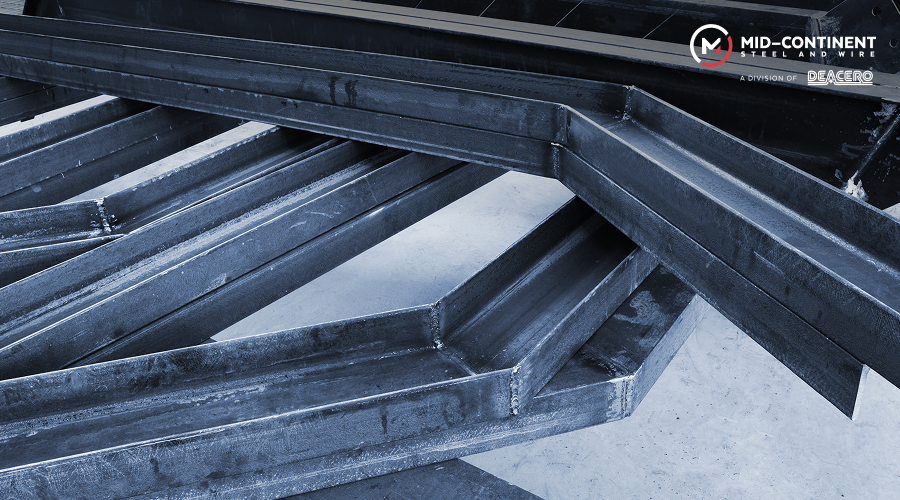
The combination of structural efficiency, ease of fabrication, and versatility makes C channel one of the most widely specified shapes across construction, manufacturing, transportation, and industrial equipment. Check out these structural applications and industrial applications:
- Structural framing — floor and wall framing, roof and ceiling supports, purlins and girts.
- Bracing and reinforcement — braces for bridges and buildings, structure reinforcements, and stiffeners.
- Supports and frameworks — equipment frames, mezzanines, racking, and warehouse shelving.
- Transportation and equipment — trailer frames, rack assembly, open-core crossbars, and machine bases.
- Fabrication — brackets, joist beam assembly, ironworks, and general metalwork.
These applications line up directly with the structural bars and shapes Mid-Continent Steel & Wire stocks for braces, framing, brackets, trailer and rack assembly, joist assembly, and ironworks — see the full Bars product line.
Can you use C channel steel in your home?
Absolutely! Lighter C channel sizes (roughly C3 through C6) are commonly used in residential and light-construction projects — garage and house framing, shelving, workbenches, bookshelves, and DIY brackets. A36 channel is easy to cut, drill, bolt, and weld, which makes it accessible for home fabrication. For any load-bearing residential application, size the member to meet your exact specifications and code and have the design checked by a professional.
Lengths, tolerances, and finishes
- Standard lengths: Structural channels and bars typically ship in 20-ft to 60-ft lengths, with shorter cut-to-length pieces available on request. At MCSW, our bars and shapes are stocked in standard 20-ft–60-ft lengths with shorter cut lengths available.
- Tolerances: Hot-rolled channels follow the dimensional tolerances in ASTM A6, which sets permissible variations for depth, flange, length, area/weight (±2.5%), and ends out of square.
- Finishes: Channel can be supplied bare (mill finish) or galvanized/primed to add a protective layer against environmental and weather corrosion.
- Testing: Charpy impact testing and material certs are available on request for projects with notch-toughness or QA requirements — MCSW offers Charpy testing on request.
Source c channel steel from Mid-Continent Steel & Wire
Mid-Continent Steel & Wire supplies a massive range of structural bars and shapes in ASTM A36, A529-50, A529-55, A992, and A572-50, in standard 20-ft–60-ft lengths with shorter cut lengths and Charpy testing available on request — engineered for braces, framing, brackets, reinforcement, trailer and rack assembly, and ironworks.
Backed by DEACERO’s vertically integrated manufacturing network, Mid-Continent Steel & Wire supplies structural bars and shapes manufactured to recognized ASTM specifications, helping fabricators, distributors, and OEMs source dependable steel for demanding structural applications. Explore our full product line or contact our team to identify the right grade, size, and length for your next project.
Frequently asked questions
What is a C type steel channel?
A C-type steel channel — the American Standard Channel, or C-shape — is a hot-rolled section with a C-shaped cross section: one web and two flanges on the same side, with inner flange surfaces tapered at the standard ~16.67% slope. It is named by depth and weight (e.g., C10×20) and is most often rolled to ASTM A36.
What is the difference between C channel steel and U channel steel?
“U channel” is a general descriptive term for any channel with a U-shaped or square-cornered profile, often referring to channels with parallel (non-tapered) inner flanges such as European UPE sections or formed/bent channels. “C channel” specifically refers to the American Standard C-shape with tapered inner flanges. In short: all C channels are a type of U-shaped channel, but not every U channel is an AISC C-shape — the defining distinction is the tapered flange and the standardized AISC designation.
What is the difference between a C channel and an MC channel?
Both are AISC channel shapes produced to A36, but a C-shape (American Standard Channel) has inner flanges tapered at the standard 16.67% slope, while an MC-shape (Miscellaneous Channel) has non-standard proportions — usually wider or deeper flanges for the same depth — giving designers more flexibility for heavier or specialized loads.
Why is C channel so expensive?
C channel pricing tracks the same drivers as other hot-rolled structural steel: raw material (steel scrap and energy) costs, the rolling and mill processing required to form the tapered-flange profile, grade (higher-strength alloys cost more than A36), size and weight per foot, plus freight and any value-added processing such as cutting, galvanizing, or testing. Heavier and larger sections use more steel per foot, so they cost more. Buying from a domestic mill or stocking distributor and ordering standard sizes and lengths typically keeps cost down versus custom or small-lot orders.