
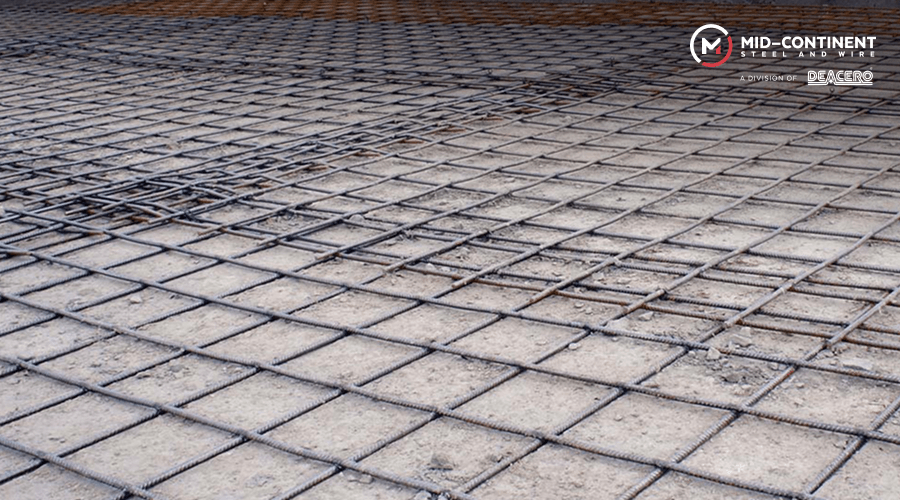

Wire mesh is a network of metal wires arranged in a regular pattern and joined by welding, weaving, or other manufacturing processes. Depending on its construction and finish, wire mesh can be used for concrete reinforcement, fencing, containment, screening, filtration, and other industrial applications. Depending on how it’s manufactured and finished, a single product family can strengthen a concrete slab, enclose livestock, support a stucco wall, or screen material on a production line. Because “wire mesh” covers so many exciting forms and uses, choosing the right one comes down to understanding the types available, the specifications that matter, and the application you’re building for. Keep reading to find out more!
This comprehensive guide walks through the main types of wire mesh, where each performs best, and the technical details that separate a good fit from a costly mistake. As an American steel manufacturer with more than 35 years of experience producing welded wire reinforcement, fencing, netting, and concrete fibers, Mid-Continent Steel & Wire brings practical manufacturing expertise to this guide to help you evaluate the right product and specification for your application.
What is wire mesh?
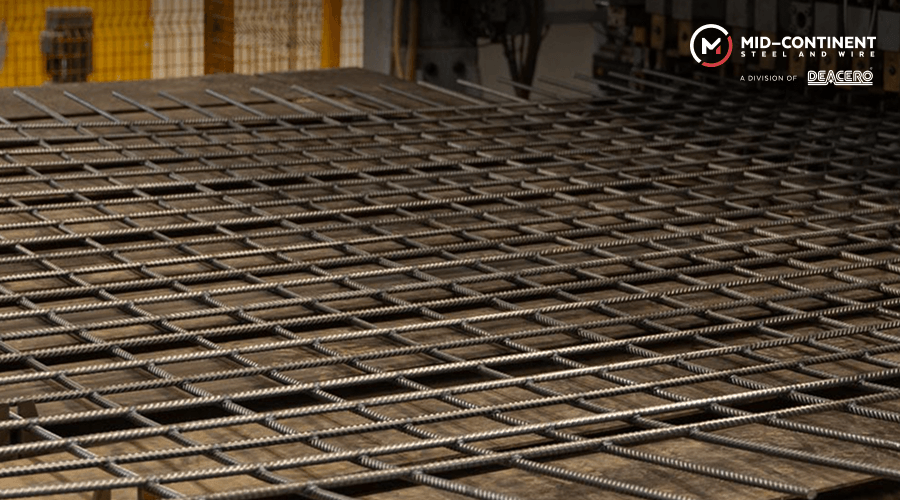
Wire mesh refers to an amazing network of interconnected metal wires arranged in a regular grid! It is commonly manufactured through several processes, including:
- Welding: Longitudinal and transverse wires are fused at their intersections, creating a rigid, dimensionally stable sheet or roll. This is the foundation of welded wire reinforcement used in concrete!
- Weaving: Wires are woven over and under one another, producing flexible mesh used for screening, fencing, and netting.
- Expanding: A solid metal sheet is slit and stretched into a diamond pattern, forming a single-piece mesh with no joints to come apart.
The wire diameter, the opening sizes, the joining method, and the protective finish all determine how a given mesh behaves under load, weather, and wear. Getting those four factors right is the key to specifying the ideal wire mesh correctly!
The main types of wire mesh
Welded wire reinforcement mesh for concrete
Welded wire reinforcement (WWR), also commonly called welded wire fabric or remesh, consists of longitudinal and transverse steel wires welded at their intersections to form a rigid, dimensionally stable grid. It strengthens concrete by adding tensile strength, the property concrete naturally lacks, and is used in slabs, sidewalks, footings, foundations, and industrial floors.
Welded wire mesh is produced with two wire types:
- W — Smooth/Plain wire
- D — Deformed wire
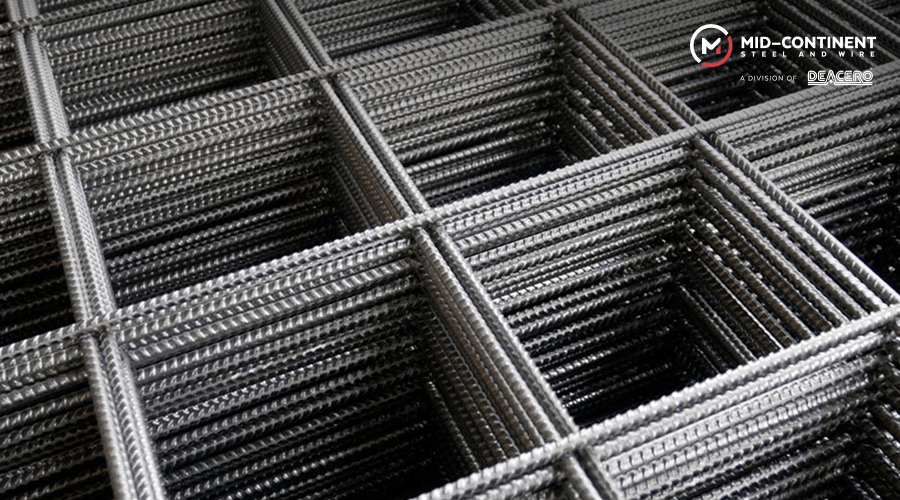
MCSW welded wire reinforcement mesh utilizes high-quality carbon steel to deliver optimal strength. It is available in wire sizes ranging from D/W 1.4 to D/W 5.0, in common opening patterns such as 4″ × 4″ and 6″ × 6″, and in both untrimmed sheets and rolls! Depending on the structural design and applicable code requirements, welded wire reinforcement can be used alone or in combination with reinforcing bars in concrete applications. Its prefabricated grid configuration can also simplify placement and installation compared with individually placed reinforcing bars.
Wire mesh and netting (Fencing and containment)
Woven and knuckled wire mesh is commonly used for fencing, containment, and enclosure applications rather than concrete reinforcement. It’s used for agricultural fencing, animal enclosures, perimeter containment, erosion control, and chain-link reinforcement. These incredible products come in a variety of gauges and heights, with finishes selected for the environment they will face — heavily galvanized steel for general outdoor use, PVC-coated for added corrosion resistance and appearance, and zinc-aluminum for extended life in harsh conditions.
Stucco netting (Plaster and masonry support)
Stucco netting is a woven wire reinforcement used to provide mechanical support and a suitable surface for plaster, stucco, and other veneer systems to adhere to. Builders typically rely on this layout because it is incredibly durable and easy to install and balances raw functionality with clean aesthetics. It’s available in furred and non-furred versions and supports Portland and gypsum plaster, one- and three-coat stucco, masonry veneer, cultured stone, and ceramic tile installations.
Steel fibers (An alternative to mesh)
For some concrete applications, loose steel fibers can replace or complement sheet and roll mesh! These hook-end filaments distribute reinforcement three-dimensionally throughout the pour and are used in industrial floors, pavements, shotcrete, and precast elements. They can be considered when three-dimensional reinforcement and distributed crack control are desired throughout the concrete matrix, depending on the project design and specified performance requirements.
Wire mesh applications in construction and industry
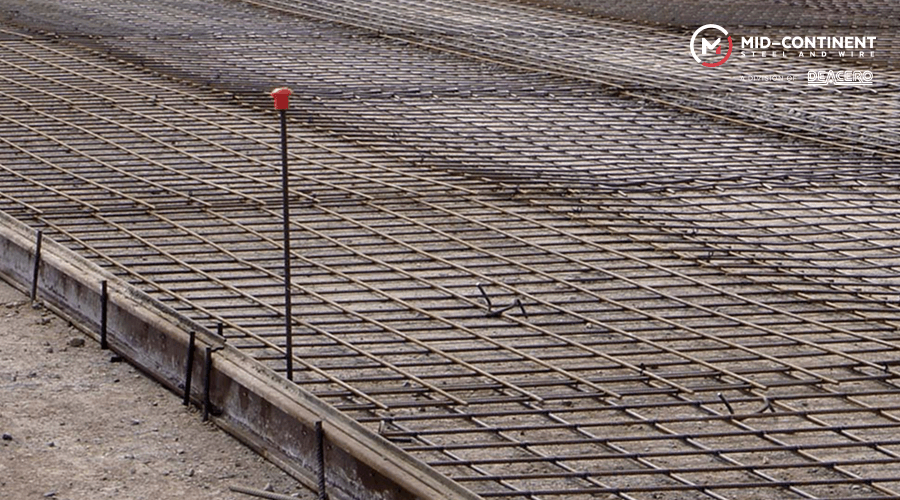
Wire mesh can provide an efficient way to add reinforcement, improve crack control, and support long-term performance in a wide range of applications. In concrete specifically, it delivers several incredible benefits:
- Tensile strength improvement: Concrete is strong in compression but weak in tension. Wire reinforcement helps provide tensile capacity where concrete is weak in tension and helps control cracking under tensile stresses.
- Crack prevention and control: The welded grid distributes localized stresses and limits the width and spread of cracks caused by shrinkage, settlement, and temperature swings.
- Load distribution: Reinforcement helps distribute stresses within the concrete and can help control crack development under service loads, depending on the structural design.
- Long-term durability: Reinforcement helps a structure hold its integrity over decades of changing loads and environmental conditions!
- Ease and speed of installation: Sheets and rolls can be cut to size and placed quickly, streamlining the pour and reducing labor time dramatically.
Beyond concrete, wire mesh provides containment, security, filtration, and screening across agriculture, manufacturing, food processing, material handling, and energy applications. Its versatility for structural components like infill panels is exactly why it appears in so many different industries!
Wire mesh sizes and specifications: how to read them
Welded wire fabric is designated by four components: two numbers for the spacing of the longitudinal and transverse wires, followed by two letter-number combinations for the wire type and size!
For example, in 6 × 8 — W8.0 × W4.0:
- 6 — spacing of longitudinal wires (inches)
- 8 — spacing of transverse wires (inches)
- W8.0 — smooth wire with a 0.08 sq. in. cross-sectional area (longitudinal)
- W4.0 — smooth wire with a 0.04 sq. in. cross-sectional area (transverse)
The leading letter tells you the wire type — W for smooth/plain, D for deformed — and the number is the cross-sectional area in hundredths of a square inch. Understanding this notation lets you compare products directly and order exactly what your engineer specified!
Choosing the right wire mesh for your project
Selecting the right wire mesh starts with the application, but the final specification should also account for load requirements, environmental exposure, installation method, and applicable standards. MCSW works with distributors, contractors, fabricators, and other industry professionals to help identify the appropriate mesh type and specification for each application.
| Application | Recommended mesh type | What to specify |
| Concrete slabs, sidewalks, footings, floors | Welded wire reinforcement mesh | Wire size (D/W 1.4–5.0), opening (4×4 or 6×6), sheet vs. roll |
| Fencing, animal enclosures, erosion control | Wire mesh and netting | Gauge, height, finish (galvanized, PVC-coated, zinc-aluminum) |
| Stucco, plaster, masonry veneer walls | Stucco netting | Furred vs. non-furred, gauge |
| Uniform 3-D concrete crack control | Steel fibers | Fiber design, dosage, application type |
| If you’re unsure which specification fits your load, span, or finish requirements, it’s always worth confirming with a manufacturer before you order! |
Frequently asked questions
What are the different types of wire mesh available on the market? The most common wire mesh products include welded wire reinforcement, woven wire mesh, knuckled wire mesh, fencing and netting, and specialized products such as stucco netting. Other related metal products, including expanded metal and steel fibers, serve different applications and should be evaluated separately based on the project’s reinforcement, containment, screening, or structural requirements.
Why is wire mesh important in construction and industrial applications? Wire mesh adds tensile strength to concrete, controls and limits cracking, distributes loads evenly, and extends the service life of a structure — all at a relatively low material and labor cost! In industrial settings it also provides containment, screening, and protection, making it one of the most versatile reinforcement materials available.
Can wire mesh be used instead of rebar for a house slab? In some residential slab applications, welded wire reinforcement may be specified instead of reinforcing bars, depending on the slab design, loading conditions, local building codes, and engineering requirements. Because the two systems are not automatically interchangeable, the reinforcement specified by the project engineer should be followed rather than substituting one for the other without approval.
Does a concrete slab need wire mesh? Most concrete slabs benefit tremendously from reinforcement! Without it, a slab is far more likely to crack under tensile stress, uneven settlement, and temperature changes. Wire mesh — or steel fibers — helps control those cracks and keeps the slab performing over its full service life. Whether mesh is required depends on the slab’s purpose and local building codes.
What types of wire mesh are best suited for poultry and animal enclosures? Woven and knuckled wire mesh and netting are designed specifically for animal enclosures! For poultry, choose a smaller mesh opening to keep birds in and predators out, an appropriate gauge for durability, and a corrosion-resistant finish such as galvanized steel mesh or PVC-coated mesh for outstanding outdoor longevity.
Source your wire mesh from a trusted american manufacturer
Mid-Continent Steel & Wire, a division of DEACERO, manufactures a broad range of wire reinforcement, fencing, netting, stucco netting, and steel fiber products to meet demanding industry requirements — including ASTM A-1064, A-641, A-824, A-390, A-740, and A-820. With more than 35 years of experience, strong inventory availability, and product expertise across multiple applications, our team can help you identify the right product and specification for your project.
Explore our full line of mesh and netting products or contact our team to discuss your application and confirm the right specifications.