
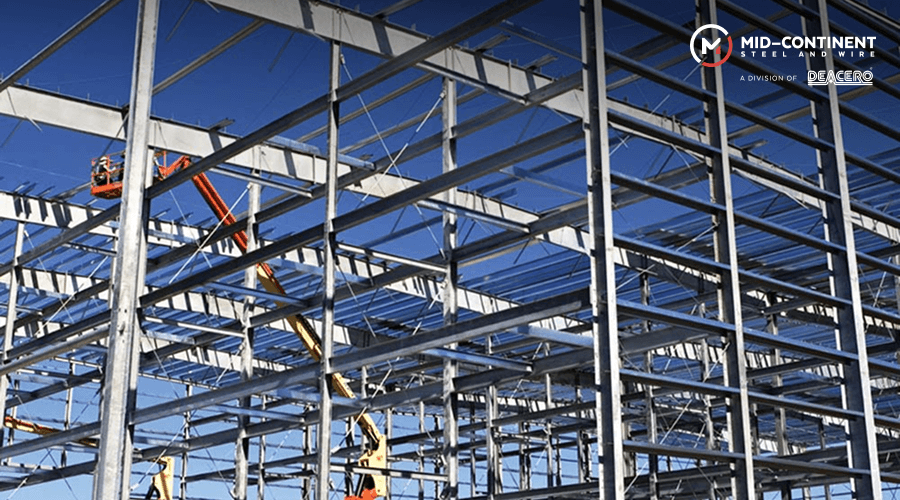

Steel beam connections are the joints where structural steel members meet and transfer load from one element to another. They create the load path that allows an entire steel frame to perform as a single structural system .A beam can be perfectly sized for its span, but if the connection that ties it to a column or girder is undersized or poorly detailed, the structure fails at the joint long before the beam itself is in any danger.
For contractors, fabricators, distributors, and infrastructure developers, understanding how these connections are classified and selected is absolutely essential to building safe, efficient, and code-compliant structures. This guide breaks down the main types of steel beam connections, the engineering principles behind them, and the key factors that determine which one belongs in your project.
At Mid-Continent Steel & Wire, backed by DEACERO, we have supplied structural steel to builders across America for more than 35 years. We work closely with fabricators and distributors who rely on consistent steel quality to support reliable fabrication, predictable connection performance, and efficient project execution.
What are steel beam connections and why do they matter?
A steel beam connection is the assembly of plates, angles, bolts, and welds that creates a beam-to-column connection or joins a beam to another structural member, such as a supporting girder. Its primary job is to carry and manage the internal forces—mainly vertical shear forces, and in some cases bending moment and axial compression— safely and predictably from one member into the next.
Here’s why connections matter: they govern how a frame behaves as a complete system. The connection type directly affects the structural behavior of the frame – whether it resists only vertical loads or also resists rotation (Helonic). Get the connection right and loads flow smoothly along their intended path to the foundation. Get it wrong and you introduce stress concentrations, unexpected rotations, or, in the worst-case scenario, brittle failure.
The consequences are well documented. After the 1994 Northridge earthquake, engineers discovered that numerous steel moment-frame buildings had suffered brittle fractures originating at the welded beam-flange-to-column-flange joints – fractures that prevented the ductile behavior the buildings were designed to deliver (IDEA StatiCa). That discovery completely reshaped how the industry approaches structural design and details connections to this day, elevating the importance of structural safety.
How steel beam connections are classified
In U.S. practice, AISC steel connections are governed primarily by the American Institute of Steel Construction’s AISC 360 Specification and, for seismic applications, by AISC 341 and AISC 358.
The most fundamental distinction is based on how much rotation the connection allows and how much resulting moment it transfers:
- Simple (shear) connections transfer vertical shear only and are assumed to allow the beam end to rotate freely. Under AISC, a simple connection must have sufficient rotation capacity to accommodate the rotation determined by analysis of the structure (IDEA StatiCa).
- Moment (rigid) connections transfer both shear and bending moment, creating a rigid joint that resists rotation and helps the frame resist lateral loads (Helonic).
- Partially restrained connections fall between the two, transferring some moment while allowing limited rotation.
A second classification is based on the fastening method: bolted, welded, or a hybrid of both. A third is based on the member geometry, such as beam-to-column, beam-to-girder, column-to-column splices, and column base plate connections.
The sections below walk through each of these in practical terms. Understanding these steel connection details helps engineers, fabricators, and contractors select the most appropriate solution for each structural application.
Common structural steel connection types used in buildings
Simple shear connections
Shear connections are the most widely used connection type in structural steel construction because they efficiently transfer vertical loads while simplifying fabrication and erection. They’re the most common connection type in steel buildings, transferring vertical load while allowing the beam end to rotate (Helonic). The most common variants include:
| Connection | Typical Use | How It Works |
| Single plate (shear tab) | Light to moderate shear | A plate shop-welded to the column or girder web, field-bolted to the beam web. The most common simple shear connection ( Helonic ). |
| Double angle | Moderate to heavy shear | Two angles, one on each side of the beam web, bolted or welded to both members; higher capacity than a single plate. |
| Single angle | Light shear | One angle shop-welded to the support, field-bolted to the beam web. Economical for lighter loads. |
| Seated connection | Light to heavy loads | An angle or plate supporting the beam’s bottom flange, with a stabilizing clip at the top; a stiffener plate is added for heavy loads. |
| Shear end plate | Moderate shear | A plate shop-welded to the beam end and field-bolted to the support; fast erection but requires tight fabrication tolerances. |
The single-plate shear connection is incredibly popular precisely because it simplifies erection: the crane lifts the beam into place and a single bolt can be slipped in and hand-tightened to secure it while the crew completes the joint (r/AskEngineers discussion).
Moment connections
Moment connections create rigid joints used for lateral load resistance and in structures requiring stiffness, and they are designated on framing plans with a solid triangle or “M” symbol (Helonic). Common types include:
- Bolted flange plate (BFP): Plates shop-welded to the column and field-bolted to the beam flanges.
- Directly welded flange: Beam flanges welded directly to the column using complete-joint-penetration (CJP) welds, the pre-Northridge standard detail.
- Bolted extended end plate: An end plate welded to the beam end that extends beyond the flanges and is field-bolted to the column.
- Reduced beam section (RBS): The “dog-bone” detail, where beam flanges are trimmed to force a controlled plastic hinge to form away from the column face, a key post-Northridge seismic innovation (Helonic).
In seismic regions, moment connections must be specially designed and detailed per AISC 358 to ensure ductile behavior during earthquakes. The current AISC 358 standard contains ten prequalified connection types, including RBS, bolted flange plate, bolted extended end-plate, and welded unreinforced flange-welded web (WUF-W), developed through the SAC Joint Venture research that followed Northridge (IDEA StatiCa). The guiding philosophy is “strong column, weak beam,” so that yielding occurs in the beam rather than at the connection or column during a major earthquake (IDEA StatiCa).
Bracing and base plate connections
Two other categories round out most steel frames:
- Bracing connections join diagonal braces to beams and columns, usually through a gusset plate, and must transfer significant axial forces (Helonic).
- Column base plate connections anchor the steel frame to the concrete foundation, transferring column loads into a concrete pedestal through anchor rods and a steel base plate.
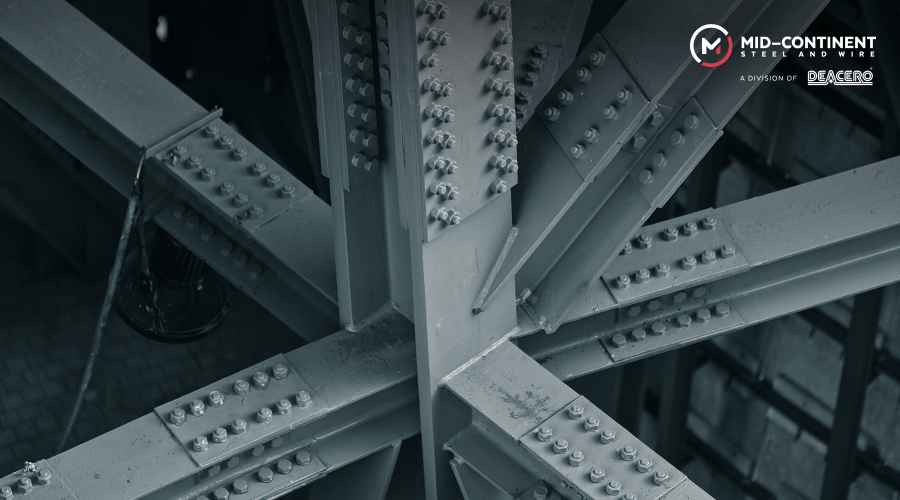
Bolted vs. welded connections: which is better?
In modern construction, the two dominant ways to connect structural steel are bolting and welding, with riveting now largely historical (SkyCiv). Each has clear strengths that make them shine in different situations.
Bolted connections use either ASTM F3125 Grade A325 high-strength bolts or common A307 bolts (SkyCiv). Their primary advantages include:
- Fast and reliable to install in the field
- Require no special weather conditions
- Allow for easy inspection
- Can be designed as either bearing-type or slip-critical joints
Because most bolting happens on site, bolted connections speed up erection and reduce the need for skilled field welders.
Welded connections commonly use fillet, groove, plug, and slot welds (SkyCiv). Their advantages include:
- Produce continuous, rigid joints with a clean appearance
- Can transfer high loads efficiently
- Create seamless load paths
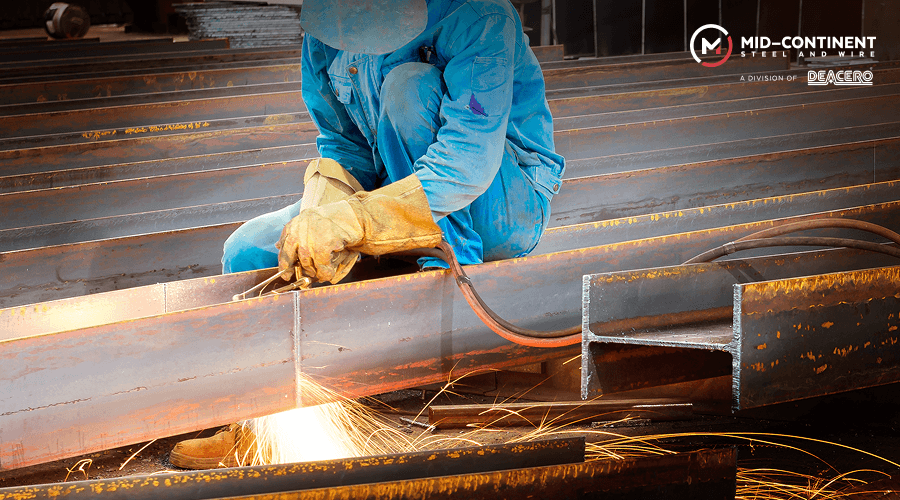
However, they demand qualified welders, careful quality control, and often a controlled shop environment.
In practice, the industry frequently combines the two, and this is common practice when an engineer determines that moment transfer is required (r/AskEngineers discussion). A classic example is a shop-welded, field-bolted connection: the connecting element is welded to the support in the controlled environment of the fabrication shop, then bolted to the beam quickly in the field. This approach combines the quality control of shop welding with the speed and efficiency of field bolting.
How are steel beam connections designed and verified?
Steel beam connection design is fundamentally a process of evaluating a series of potential limit states, each representing a possible failure mode that engineers must verify before construction begins. For a typical bolted shear connection designed to AISC 360, engineers verify (SkyCiv):
- Bolt shear – will the bolts shear off?
- Bolt bearing and tearout – will the bolts crush or tear through the plate or beam web?
- Shear yielding of the connecting plate or beam web.
- Shear rupture through the net section at the bolt holes.
- Block shear rupture – a combined tearing-and-shearing failure pulling out a block of material.
Each limit state is checked so that the connection’s available strength exceeds the required strength, using either the LRFD (load and resistance factor design) or ASD (allowable strength design) approach permitted by AISC. For moment connections, additional checks come into play, such as flange local bending, web local yielding, web local crippling, and panel-zone shear in the supporting column (CalcBook).
This is precise, engineered work that requires expertise. Connections should always be designed by, or under the direction of, a qualified structural engineer for the specific loads and code requirements of the project.
Factors that influence connection selection
Connection selection should always be based on project-specific structural, economic, and constructability requirements. The optimal choice balances several key factors:
- Load type and magnitude. Pure vertical load points toward a simple shear connection; required lateral stiffness or seismic demand points toward a moment connection.
- Lateral and seismic requirements. In high-seismic regions, prequalified AISC 358 moment connections are often mandatory for special and intermediate moment frames (IDEA StatiCa).
- Erection speed and labor. Bolted, field-assembled connections typically erect faster and need less specialized field labor than welded ones.
- Fabrication economy. Simpler details with fewer plates and bolts cut both shop and field cost.
- Inspection and quality control. Bolted joints are easier to inspect visually; welds may require ultrasonic or other nondestructive testing.
- Service environment. Exterior, coastal, or industrial exposures demand corrosion protection (see below).
- Member geometry. Wide-flange, HSS (hollow structural section), and built-up members each call for different connection details. For HSS-to-HSS joints, for instance, detailing must preserve the rotation a simple connection requires while still transferring the design forces (Steel Tube Institute).
How to protect steel beam connections from corrosion
Connections concentrate edges, faying surfaces, and crevices where moisture can collect, making corrosion protection a real design consideration – especially for exposed or aggressive environments. Hot-dip galvanizing is one of the most widely used and durable methods, providing both a barrier coating and cathodic (sacrificial) protection to the underlying steel (American Galvanizers Association). Other strategies include protective paint systems and weathering steel, each chosen based on the exposure category and the intended service life of the structure.
How connections affect structural integrity
Because connections are the load path between members, their behavior defines the behavior of the whole frame. A correctly classified and detailed connection ensures:
- Forces flow as the design assumed
- Simple connections rotate as intended
- Moment connections stay rigid
- The structure responds predictably to gravity, wind, and seismic loads
When connections are misclassified or poorly executed, the consequences propagate throughout the entire system. A connection assumed to be “simple” but actually restraining rotation can attract unanticipated moments and overstress the members it joins. Conversely, a moment connection that fails to develop its design strength can compromise an entire lateral system – exactly the lesson of Northridge, where brittle weld fractures prevented the ductile yielding the buildings were designed to rely on (IDEA StatiCa). In short, connection integrity equals structural integrity.
Frequently asked questions
What are steel beam connections and why are they important in construction? Steel beam connections are the bolted and/or welded joints that tie beams to columns, girders, and other members, transferring load between them. They are absolutely critical because steel structure transfers force through these joints; a weak or poorly detailed connection can fail before the beam itself, compromising the whole frame.
How are steel beam connections designed and installed? They are engineered to AISC standards by checking a series of limit states, such as bolt shear, bearing, shear yielding, shear rupture, and block shear for a bolted connection, so that available strength exceeds demand (SkyCiv). Installation typically combines shop fabrication (often welding) with field assembly (often bolting) for optimal speed and quality.
What are the common types of steel beam connections used in buildings? The most common are simple shear connections (single-plate/shear tab, double angle, single angle, seated, and shear end plate) for vertical load, and moment connections (bolted flange plate, directly welded flange, bolted end plate, and reduced beam section) for rigid frames that resist lateral and seismic loads (Helonic).
What factors influence the selection of steel beam connections for a project? Load type and magnitude, lateral and seismic requirements, erection speed and labor availability, fabrication cost, inspection needs, the service environment (corrosion exposure), and member geometry all influence the choice. There is no universal best connection – only the best fit for a given set of conditions.
How do steel beam connections affect the structural integrity of a building? Connections are the load path between members, so they determine how the frame behaves as a system. Properly classified connections ensure load flow as designed; misclassified or defective connections can introduce unintended forces or brittle failures, as the 1994 Northridge earthquake demonstrated (IDEA StatiCa).
Build stronger connections with MCSW USA
Every successful steel beam connection design begins with reliable steel and consistent manufacturing quality. For more than 35 years, Mid-Continent Steel & Wire has supplied high-quality structural steel to contractors, fabricators, distributors, and infrastructure developers across America, backing modern construction and industrial manufacturing with products engineers can trust.
Whether you’re framing a multi-story office building, a warehouse, or an industrial facility, our team is ready to present the best materials to help you source the structural steel that performs in the field and holds up at the joint.
With more than 35 years of experience and the strength of DEACERO behind every product, Mid-Continent Steel & Wire delivers dependable structural steel solutions for demanding construction projects across North America. Contact Mid-Continent Steel & Wire today to talk to our structural steel specialists and discover how we can support your next construction project!